


ÖNEMLİ ÖZELLİKLER
| Tam Ad | Glutathione S Transferase Mu 3, Brain |
|---|---|
| Eşanlamlı | GST-M3,GST5,GSTB,GSTM3-3,GTM3 |
| Test Tipi | Sandviç |
| Reaktivite | İnsan |
| Aralık | 0.31-20ng/mL |
| Duyarlılık | 0.12ng/mL |
| Örnek Tipi | Serum, plazma ve diğer biyolojik sıvılar |
| Örnek Hacmi | 100μL |
| Tespit Dalga Boyu | OD450 |
| Taşıma Sıcaklığı | 2-8°C |
| Özgüllük | Kit, örneklerde İnsan GSTm3'ü tespit etti ve türler arası önemli bir reaksiyon bulunamadı |
| Mikroplaka | 96 kuyulu plak, 12 x 8 kuyuluk şeritlere bölünebilir |
TEST İLKESİ
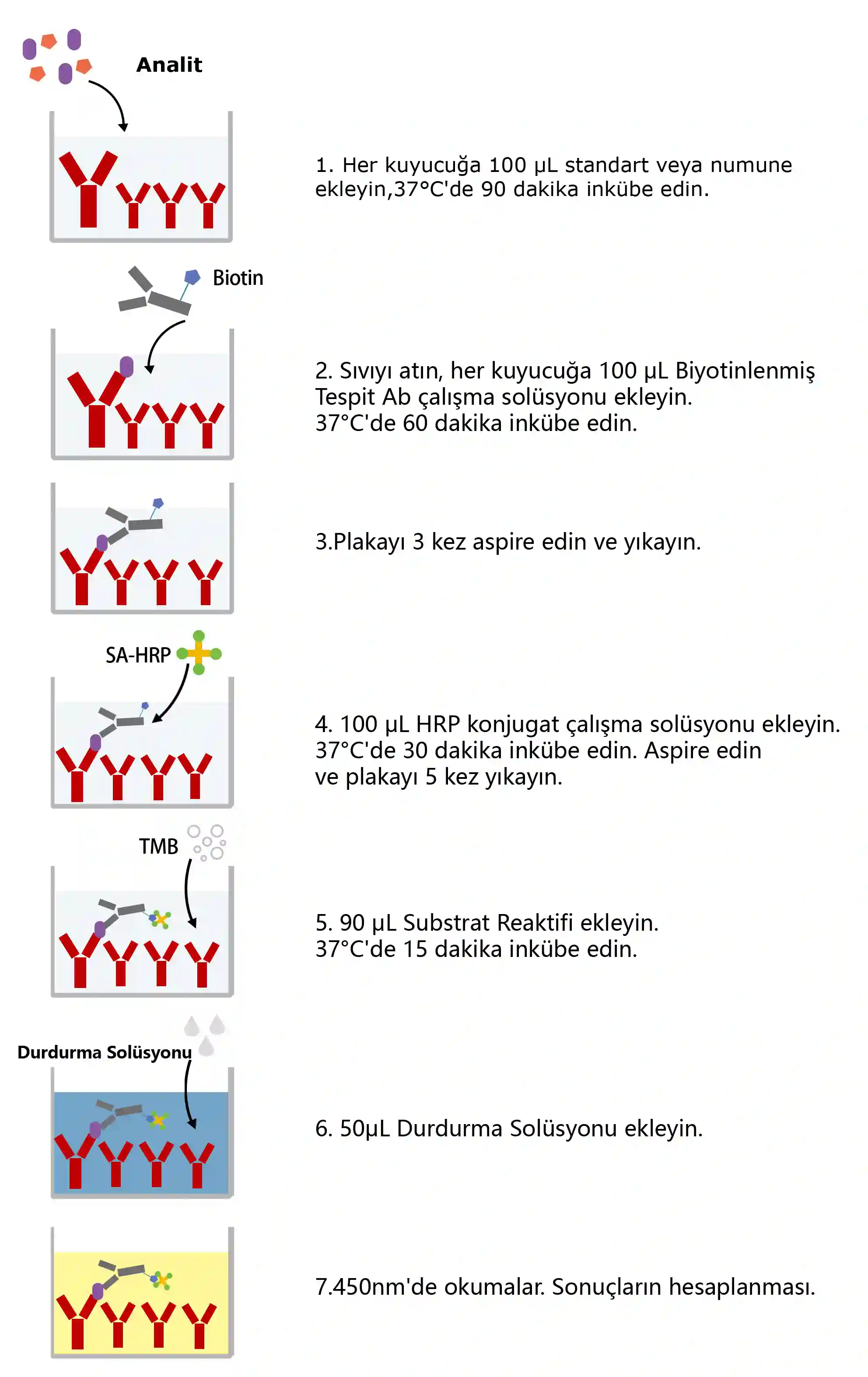
| Bu ELISA kiti, Sandviç-ELISA prensibini kullanır. Bu kitte sunulan mikro ELISA plakası, İnsan GSTm3'e özgü bir antikorla önceden kaplanmıştır. Standartlar veya numuneler mikro ELISA plakası kuyucuklarına eklenir ve özgül antikorla birleştirilir. Ardından, İnsan GSTm3'e özgü biyotinlenmiş bir tespit antikoru ve Avidin-Yaban Turpu Peroksidaz (HRP) konjugatı her bir mikro plaka kuyucuğuna sırayla eklenir ve inkübe edilir. Serbest bileşenler yıkanır. Her bir kuyucuğa substrat çözeltisi eklenir. Yalnızca İnsan GSTm3, biyotinlenmiş tespit antikoru ve Avidin-HRP konjugatı içeren kuyucuklar mavi renkte görünür. Enzim-substrat reaksiyonu, durdurma çözeltisinin eklenmesiyle sonlandırılır ve renk sarıya döner. Optik yoğunluk (OD), 450 nm ± 2 nm dalga boyunda spektrofotometrik olarak ölçülür. OD değeri, İnsan GSTm3 konsantrasyonuyla orantılıdır. Numunelerdeki İnsan GSTm3 konsantrasyonunu, numunelerin OD'sini standart eğri ile karşılaştırarak hesaplayabilirsiniz. |
ELISA KIT BILEŞENLERİ
Teslim alındıktan sonra, talimatlarda önerildiği gibi derhal paketini açın ve depolayın.
| Bileşenler | Teknik Özellikler | Depolama ve Notlar |
|---|---|---|
| Mikro Plaka | 96T: 8 kuyu×12 şerit 48T: 8 kuyu×6 şerit | Açılmamış: -20°C, 12 ay Kullanılmamış: Aluminyum folyo torbasına geri koyun ve kapatın, -20°C'de saklayın. |
| Referans Standart | 96T: 2 flakon 48T: 1 flakon | Açılmamış: -20°C, 12 ay Her deney için taze çözülmüş standartlar kullanın. Çözülmeden sonra kullanılmayan standartları atın. |
| Biotinileştirilmiş Tespit Antikor Konsantresi (100×) | 96T: 120μL×1 flakon 48T: 60μL×1 flakon | Açılmamış: -20°C, 12 ay Kullanılmamış: Konsantresi kapatın ve -20°C'de saklayın, çalışma solüsyonunu atın. |
| HRP Konjugatı Konsantresi (100×) | 96T: 120μL×1 flakon 48T: 60μL×1 flakon | Açılmamış: -20°C(Işık koruması), 12 ay Kullanılmamış: Konsantresi kapatın ve -20°C'de saklayın, çalışma solüsyonunu atın. |
| Biotinileştirilmiş Tespit Antikor Seyreltici | 14mL×1 flakon | 2-8℃, 12 ay |
| HRP Konjugatı Seyreltici | 14mL×1 flakon | 2-8℃, 12 ay |
| Referans Standart & Örnek Seyreltici | 20mL×1 flakon | 2-8℃, 12 ay |
| Yıkama Tamponu Konsantresi (25×) | 30mL×1 flakon | 2-8℃, 12 ay |
| Substrat Reajenti(TMB) | 10mL×1 flakon | 2-8°C(Işık koruması),12 ay |
| Durdurma Solüsyonu | 7mL×1 flakon | 2-8°C/Oda sıcaklığı |
TEST PROSEDÜRLERİ
TİPİK VERİLER
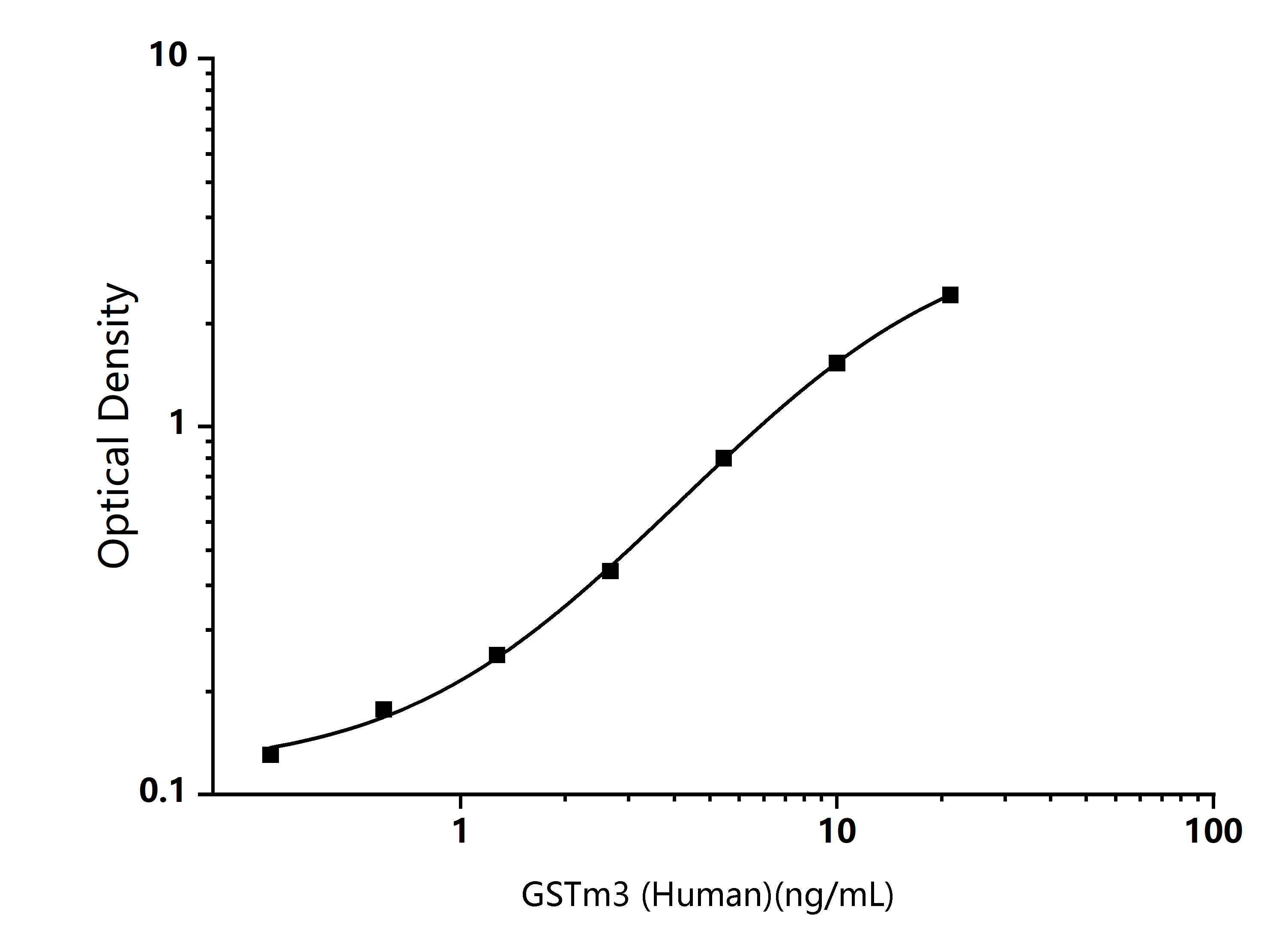
İnsan GSTm3 ELISA Standart Eğrisi
Tipik veriler yalnızca referans olarak sunulmuştur ve eğriler her deney için yeniden çizilmelidir. Uyarlama için Lojistik fonksiyon önerilir.
HASSASİYET
Test İçi Hassasiyet (Bir test içindeki hassasiyet): Test içi hassasiyeti değerlendirmek için bilinen konsantrasyonlara sahip üç örnek bir plakada yirmi kez test edildi.
Testler Arası Hassasiyet (Testler arasındaki hassasiyet): Testler arası hassasiyeti değerlendirmek için bilinen konsantrasyonlara sahip üç örnek yirmi ayrı testte test edildi. Testler, en az üç teknisyen tarafından iki parti bileşen kullanılarak gerçekleştirildi.
| Test İçi Hassasiyet | Testler Arası Hassasiyet | |||||
|---|---|---|---|---|---|---|
| Örnek | 1 | 2 | 3 | 1 | 2 | 3 |
| n | 20 | 20 | 20 | 20 | 20 | 20 |
| Ortalama (ng/mL) | 1.01 | 2.76 | 9.52 | 1.03 | 2.96 | 9.59 |
| Standart Sapma | 0.06 | 0.11 | 0.32 | 0.07 | 0.16 | 0.5 |
| CV(%) | 6.04 | 4.09 | 3.38 | 6.88 | 5.31 | 5.2 |
GERİ DÖNÜŞÜM
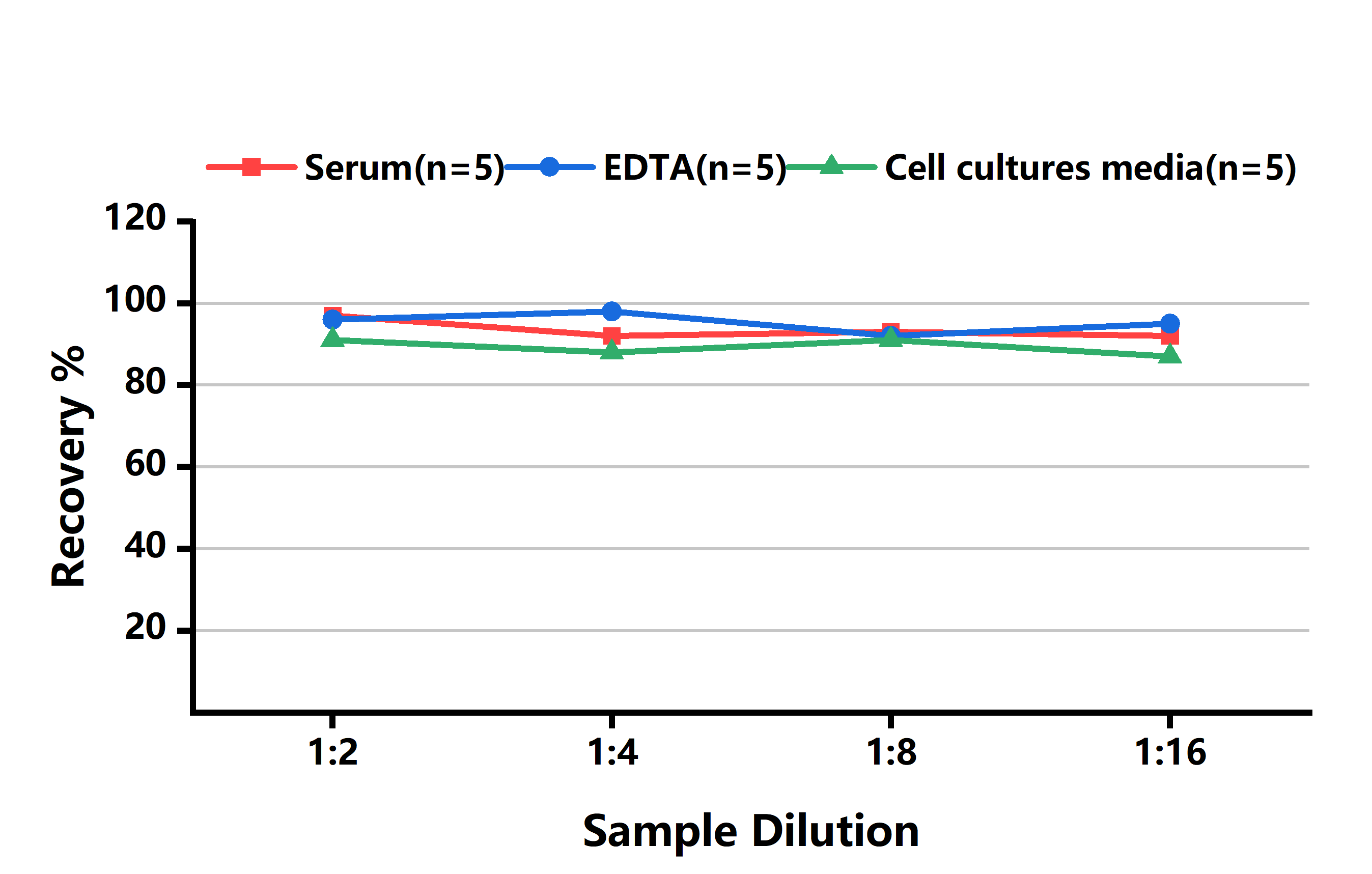
Çeşitli matrikslerde test aralığının tamamında örneklerde üç farklı düzeye ekilen İnsan GSTm3'ün geri dönüşü değerlendirildi.
| Örnek Tipi | Aralık (%) | Ortalama Gerçekleşme (%) |
|---|---|---|
| Serum(n=8) | 87-103 | 94 |
| EDTA plazması (n=8) | 94-106 | 100 |
| Hücre kültürü ortamı (n=8) | 85-97 | 90 |
DOĞRULUK
Testin doğruluğunu değerlendirmek için, çeşitli matrikslerde yüksek konsantrasyonlarda İnsan GSTm3 içeren ve/veya ilave edilmiş örnekler, testin dinamik aralığında değerlere sahip örnekler üretmek için Referans Standart & Örnek Seyrelticide seyreltildi.
Products associated with GSTM3 ELISA Kits
| CYP1A1 ELISA Kit | publications with GSTM3 and CYP1A1 |
| GSTM2 ELISA Kit | publications with GSTM3 and GSTM2 |
| CYP1B1 ELISA Kit | publications with GSTM3 and CYP1B1 |
| CYP2E1 ELISA Kit | publications with GSTM3 and CYP2E1 |
| EPHX1 ELISA Kit | publications with GSTM3 and EPHX1 |
| GSTO1 ELISA Kit | publications with GSTM3 and GSTO1 |
| CYP2C19 ELISA Kit | publications with GSTM3 and CYP2C19 |
| GSTZ1 ELISA Kit | publications with GSTM3 and GSTZ1 |
Pathways associated with GSTM3 ELISA Kit
| Biological Oxidations Pathway | Biological Oxidations Pathway |
| Chemical Carcinogenesis Pathway | Chemical Carcinogenesis Pathway |
| Defective AHCY Causes Hypermethioninemia With S-adenosylhomocysteine Hydrolase Deficiency (HMAHCHD) Pathway | Defective AHCY Causes Hypermethioninemia With S-adenosylhomocysteine Hydrolase Deficiency (HMAHCHD) Pathway |
| Defective GCLC Causes Hemolytic Anemia Due To Gamma-glutamylcysteine Synthetase Deficiency (HAGGSD) Pathway | Defective GCLC Causes Hemolytic Anemia Due To Gamma-glutamylcysteine Synthetase Deficiency (HAGGSD) Pathway |
| Defective GGT1 Causes Glutathionuria (GLUTH) Pathway | Defective GGT1 Causes Glutathionuria (GLUTH) Pathway |
| Defective GSS Causes Glutathione Synthetase Deficiency (GSS Deficiency) Pathway | Defective GSS Causes Glutathione Synthetase Deficiency (GSS Deficiency) Pathway |
| Defective MAT1A Causes Methionine Adenosyltransferase Deficiency (MATD) Pathway | Defective MAT1A Causes Methionine Adenosyltransferase Deficiency (MATD) Pathway |
| Defective OPLAH Causes 5-oxoprolinase Deficiency (OPLAHD) Pathway | Defective OPLAH Causes 5-oxoprolinase Deficiency (OPLAHD) Pathway |
| Defective SLC35D1 Causes Schneckenbecken Dysplasia (SCHBCKD) Pathway | Defective SLC35D1 Causes Schneckenbecken Dysplasia (SCHBCKD) Pathway |
Diseases associated with GSTM3 ELISA Kit
| Lung Neoplasms | publications with GSTM3 and Lung Neoplasms |
| Liver Diseases | publications with GSTM3 and Liver Diseases |
| Nervous System Diseases | publications with GSTM3 and Nervous System Diseases |
| Liver Neoplasms | publications with GSTM3 and Liver Neoplasms |
| Colorectal Neoplasms | publications with GSTM3 and Colorectal Neoplasms |
| Carcinoma, Hepatocellular | publications with GSTM3 and Carcinoma, Hepatocellular |
| Necrosis | publications with GSTM3 and Necrosis |
| Breast Neoplasms | publications with GSTM3 and Breast Neoplasms |
| Disease Models, Animal | publications with GSTM3 and Disease Models, Animal |
| Neoplasms, Experimental | publications with GSTM3 and Neoplasms, Experimental |
Organs/Tissues associated with GSTM3 ELISA Kit
| Lung | publications with GSTM3 and Lung |
| Blood | publications with GSTM3 and Blood |
| Liver | publications with GSTM3 and Liver |
| Brain | publications with GSTM3 and Brain |
| Skin | publications with GSTM3 and Skin |
| Kidney | publications with GSTM3 and Kidney |
| Mouth | publications with GSTM3 and Mouth |
| Bladder | publications with GSTM3 and Bladder |
| Eye | publications with GSTM3 and Eye |
| Testis | publications with GSTM3 and Testis |