
Slug (SNAI2) is a widely expressed transcriptional repressor and member of the Snail family of zinc finger transcription factors. Similar to the related Snail protein, Slug binds to the E-cadherin promoter region to repress transcription during development.
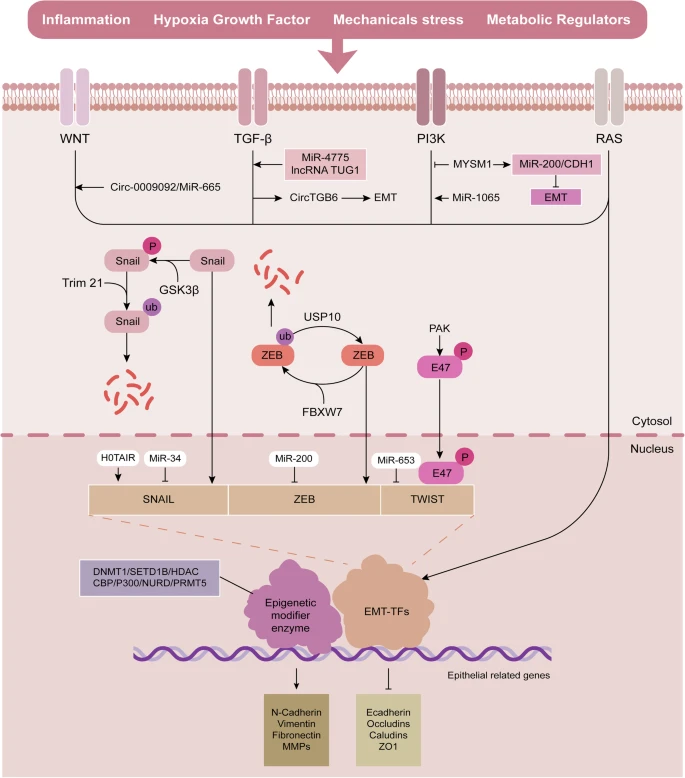
EMT is regulated by a complex network involving transcriptional regulation, post-translational modifications, epigenetic modifications, non-coding RNAs, and signaling pathways.
| Catalog# | Product Name | Application | Reactivity |
|---|---|---|---|
| AMRe21330 | Vimentin Rabbit Monoclonal antibody | WB,IHC,IF,IP,ELISA | Human,Mouse,Rat |
| AMRe21484 | N Cadherin Rabbit Monoclonal antibody | WB,IHC,IF,IP,ELISA | Human,Mouse,Rat |
| AMRe21480 | Claudin 1 Rabbit Monoclonal antibody | WB,IHC,IF,IP,ELISA | Human,Mouse,Rat |
| AMRe21395 | β Catenin Rabbit Monoclonal antibody | WB,IHC,IF,IP,ELISA | Human,Mouse,Rat |
| AMRe21195 | ZO1 Rabbit Monoclonal antibody | WB,IHC,IF,IP,ELISA | Human,Mouse,Rat |
| AMRe86416 | SNAI1 (DGR18395) Rabbit mAb | WB, IP | Human |
| AMM81417 | SNAI2 Mouse Monoclonal Antibody | WB,IHC,ICC,FC,ELISA | Human |
| AMRe21526 | AREB6 Rabbit Monoclonal antibody | WB,IHC,IF,IP,ELISA | Human,Rat |
| AMRe01411 | E Cadherin Rabbit Monoclonal Antibody | WB,IHC-F,IHC-P,ICC/IF,IP | Human |
| APS0635 | HRP-conjugated Polyclonal Goat Anti-Rabbit IgG(H+L) Secondary Antibody | ELISA,WB,Dotblot | Mouse |
| APS0631 | HRP-conjugated Polyclonal Goat Anti-Mouse IgG(H+L) Secondary Antibody | ELISA,WB,Dotblot | Mouse |
| AMRe80004 | GAPDH (12R9) Rabbit Monoclonal Antibody | WB,ELISA | Human,Mouse,Rat,Rabbit,Dog,Monkey |
- Antibody Labeling Kit
- Western Blot Kits
- Super-sensitive ECL chemiluminescent reagent
- IHC Kit
- TSA mIHC Kits
- Aigner, K. et al. (2007) Oncogene 26, 6979-88.
- Peinado, H. et al. (2007) Nat Rev Cancer 7, 415-28.
- Moreno-Bueno, G. et al. (2008) Oncogene 27, 6958-69.
- Wheelock, M.J. and Johnson, K.R. (2003) Annu Rev Cell Dev Biol 19, 207-35.
- Christofori, G. (2003) EMBO J 22, 2318-23.
- Hazan, R.B. et al. (2004) Ann N Y Acad Sci 1014, 155-63.
- Shin, K. et al. (2006) Annu Rev Cell Dev Biol 22, 207-35.
- Oliveira, S.S. and Morgado-Díaz, J.A. (2007) Cell Mol Life Sci 64, 17-28.
- Matter, K. and Balda, M.S. (2007) J Cell Sci 120, 1505-11.
- Hernandez, S. et al. (2007) Exp Cell Res 313, 1533-47.
- Umeda, K. et al. (2006) Cell 126, 741-54.
- Reichert, M. et al. (2000) J Biol Chem 275, 9492-500.
- Helfand, B.T. et al. (2004) J Cell Sci 117, 133-41.
- Cadigan, K.M. and Nusse, R. (1997) Genes Dev 11, 3286-305.
- Wodarz, A. and Nusse, R. (1998) Annu Rev Cell Dev Biol 14, 59-88.
- Polakis, P. (1999) Curr Opin Genet Dev 9, 15-21.
- Inukai, T. et al. (1999) Mol Cell 4, 343-52.
- Bolós, V. et al. (2003) J Cell Sci 116, 499-511.
- Turner, F.E. et al. (2006) J Biol Chem 281, 21321-31.
- Barrallo-Gimeno, A. and Nieto, M.A. (2005) Development 132, 3151-61.
- Nie, F. et al. (2025) Cell Death Discov. 11, 336.
 | Voisey Voisey is a technical support specialist at EnkiLife, proficient in immunology and cell biology. She is committed to providing customers with professional and efficient technical support. Additionally, she is involved in research on customers' fields of study and designs highly cost-effective solutions for them. |